Egon Schiele's Self Portraits

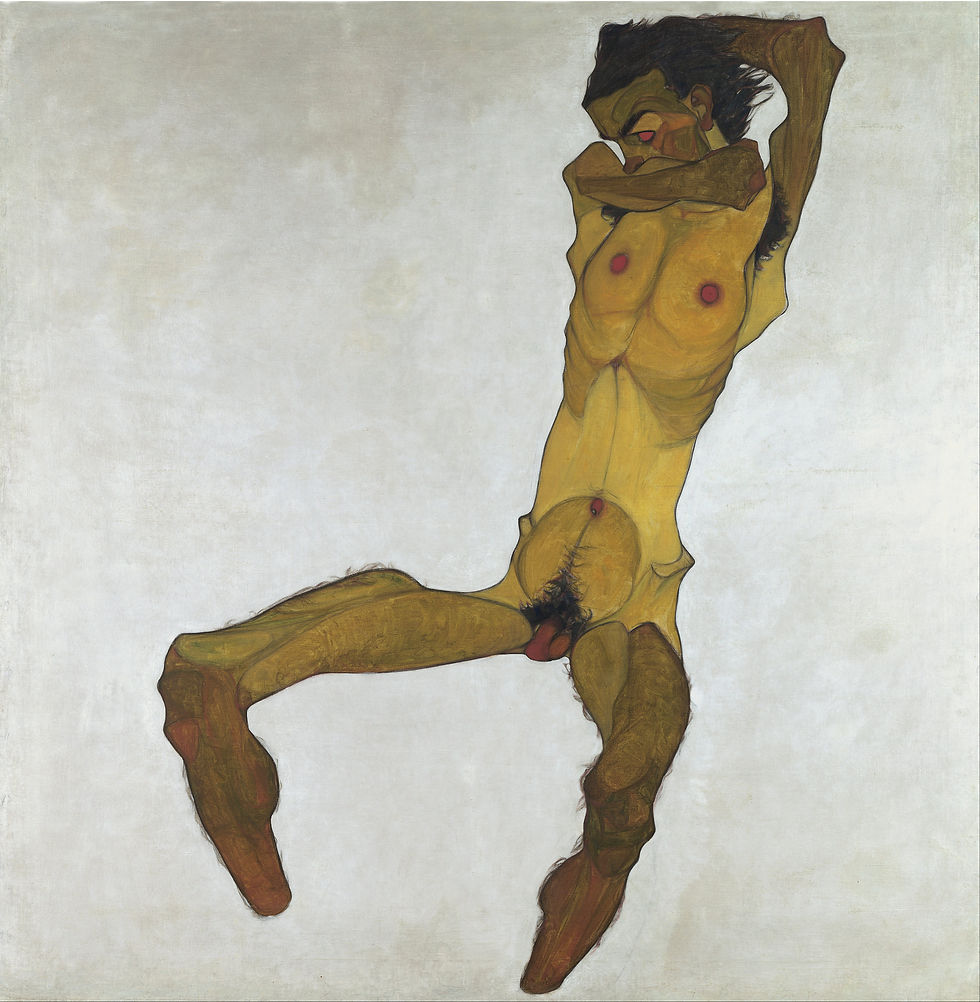
Egon Schiele, Seated Male Nude (Self-Portrait), 1910, oil on canvas, 152.5 x 150 cm
Like many artists, Egon Schiele has a motif that occurs time and time again within his body of work. Throughout his short life, Schiele managed to create around twenty-five hundred drawings, gouaches, and watercolors that showcased a unique highly sexual artistic viewpoint (The Independent). With around a hundred self-portraits in the collection that is Schiele's work, it is easy to notice the change Schiele put forth from portraiture that preceded him (Steiner 7). Like a great deal of Egon Schiele's depictions of people, he created nude paintings and drawings that “broke entirely the customary of self portraits” (Smola 91). Although Egon Schiele's “Seated Male Nude (Self Depiction)” was seen as pornographic imagery in his time, the piece along with Schiele's other portraits explore the nature of humanity, sexuality, and death at the height of Expressionism.
Gustav Klimt was Schiele's first great influence with his elongated female figures that can be linked to Schiele's fascination with sexual imagery and the nude human form (Smola 91). Accepted into the Vienna Academy of Fine Arts at the young age of sixteen, Schiele made a drastic decision to leave the academy in 1909 to form the Neukunstgruppe or New Art Group (Comini 9). Under Klimt's invitation, Schiele's first independent works were showcased in 1909 at Vienna's Internationalkunstschau (Comini 12). A series of self portraits that Schiele created from 1909 through 1912, including his “Seated Male Nude” painted in 1910 that “constituted a theater of the self in which exhibitionism, narcissism, and sexual gratification battle for center stage” (Comini 14). In his self portraits in the nude, Schiele is putting himself on display as “a sexual creature” (Steiner 13). In “Seated Male Nude” or “Self Portrait Nude” as it is also called, Schiele depicts himself with his legs straddled open and his arms raised, partly covering his face (Smola 91). His skeletal body against a stark white background accentuates the expressive qualities of the work while at the same time creating a well-balanced composition.
Stylistically, Schiele drew from the “emphaticy linearity” portrayed in Klimt's figures as well as the thick contours portrayed in Ferdinand Hodler's work (Smola 91) (Comini 13). The use of the line was vital in Schiele's brand of Expressionism more so than the use of color although Schiele's use of color was a distinguishable attribute in his work (Comini 14). His style was a new defining factor of Expressionism in the the 20th century that grew off of but entirely reinvented the style of Klimt. Both Schiele and Klimt touched on the topic of death and sexuality through the portrayal of human figures juxtaposed with geometric and organic line and shapes. Schiele's thin figure has an unnatural contortion to the body and “seems somehow locked inside itself” (leopoldmuseum.org). He colored himself a shade of yellow-green that looks sickly with a whisp of black hair and touches of red on his nipples, belly button, and genitalia. The combination of Schiele's black contours, idealized colors, and geometric approach to his elongated figures produced work that was both dramatically expressive and analytical of his personal psyche (Smola 90). Schiele's self portrayals are not soft or self-flattering in any way but are instead an insight into the mind of a man exploring the essence of human existence in an emotionally relatable way. His portrayals of himself are linked to his many expressive and symbolic writings in which he “articulated his psychological distress and melancholy” (Smola 93). The new science of psychology promoted by artists, writers, and philosophers no longer sought to understand the journey of the soul but were now instead focused on the phenomenon of the self and pure existence (Comini 9). One can speculate that Schiele was an extremely self-aware and self-absorbed person. His work distorted himself and had an anxious, often lonely feel to it. Existential considerations had just come into culture during Schiele's time and the principles of it are abundant in Schiele's work as well as in the rise of Expressionism in the 1900's (Yeh 150). Existentialism explored individuality, self-control, and man's fear of death (Yeh 152). As said by Gabriel Marcel, “There is but one suffering, that is loneliness” (155). Schiele's self portraits are bound to the page in such a way that they almost seem imprisoned within the confined space of the paper. Drawing from the ideas of philosopher Friedrich Wilhelm Nietzshe, Schiele's style opposed the “harmoniously stylized art” that was most abundant in Vienna at the turn of the century (Smola 91).
The initial reaction of the general public to Schiele's work was not flattering for the artist. Schiele's first drawings and paintings were described as “weak imitations of Klimt” (Smola 91). Yet as Schiele grew as an artist, his work developed a unique style that expressed intensity and a new way of exploring personal psyche and human sexuality. Prior to Schiele's work, the use of such a simplified white background had hardly ever been done before (leopoldmuseum.org). The way with which Schiele portrayed himself and his subjects, although highly sexual did not have a pleasurable erotic nature (Campbell-Johnston). His creations had a distorted sadness and appeared worried while addressing the taboo attitudes of sex and masturbation (Campbell-Johnston). In his time period, Schiele's many portraits were considered pornographic and in 1912, he was sentenced three days of imprisonment after a judge lit one of his drawings on fire in the courtroom (Campbell-Johnston). Schiele was a leading figure in Austrian and more broadly European Expressionism with an influence on artistic creation that has inspired many artists and designers since his lifetime. Modern day illustrators especially draw inspiration from Schiele's simplistic and contorted designs. Figures resembling the stretched out, almost skeletal figures of Schiele's body of work can now be seen in any fashion magazine and although self portraiture has been around for as long as the creation of art itself, Schiele really inspired a consistant exploration of human behaviors through his self-depicted images. He was the first man to change the gaze onto his own nude body which not only developed throughout Expressionism but the idea of the male as an object of desire has changed the course of art history. With the greatest aspects of his career shortly before and during World War One, Schiele's drawings expressed humanitarian self-pity that was sensed throughout Europe at the time (Comini 20). The narcissism portrayed in Schiele's commitment to the self-portrait showcases the artist's desire to understand his place in a shocking and terrifying world. Before his time, sex was simply not discussed even though it is the very nature of human existence. Schiele highlighted what he believed to be the most influential aspect of the pathos of humanity; sexual desires.
With an acute interest in human nature and the inevitable end of life, Schiele created works of art such as his “Seated Male Nude” that redefined portraiture, mostly of the self. His drawings may contain sexualized content but they produce a greater understanding of human nature through sex and pain than the acceptable classic statue and drawing of the academy. He created a body of work that reflected the most important pieces of the human psyche and portrayed himself in a way that made him as vulnerable as the many young women he depicted if not more and advanced Expressionism to a degree that challenged typical portrayals of religious and otherwise soul-searching. Schiele created work that “glimmers the full passion of an existence” in the short decade that was his career (leopoldmuseum.org). His work depicts the struggles within each person of choosing self-being versus mutual-being. Schiele once said, “The new artist is and must at all costs be himself. He must be a creator. He must build the foundation himself” (Yeh). Schiele did exactly that with his fragile, contorted figures that “penetrate the personalities of his sitters. He is a discoverer who knows souls, a revealer of the most hidden secrets” (Yeh). In his work, one can feel the eternal themes of human nature that have been questioned throughout the existence of mankind; what does it mean to be human?
Works Cited
Campbell-Johnston, Rachel. "The 'pornographic' Drawings of Egon Schiele." The Independent. 10 Aug. 2011. Web. 2 Mar. 2012.
Comini, Alessandra. Egon Schiele. New York, NY: George Braziller, 1976. Print.
"Masters of the Collection." Leopold Museum. Web. 8 Mar. 2012.
Smola, Franz. "Egon Schiele: Symbolist Death-Wish and Expressionist Affirmation." Vienna 1900: Klimt, Schiele, and Their times : A Total Work of Art. Ed. Hantje Cantz. Riehen: Beyeler Museum AG, 2010. 91-148. Print.
Yeh, Jin_Tsann. "Being-there: An Existentialism Point of View in Egon Schiele's Self portraits." Ed.arte.gov. The International Journal of Arts Education. Web. 4 Mar. 2012.

